

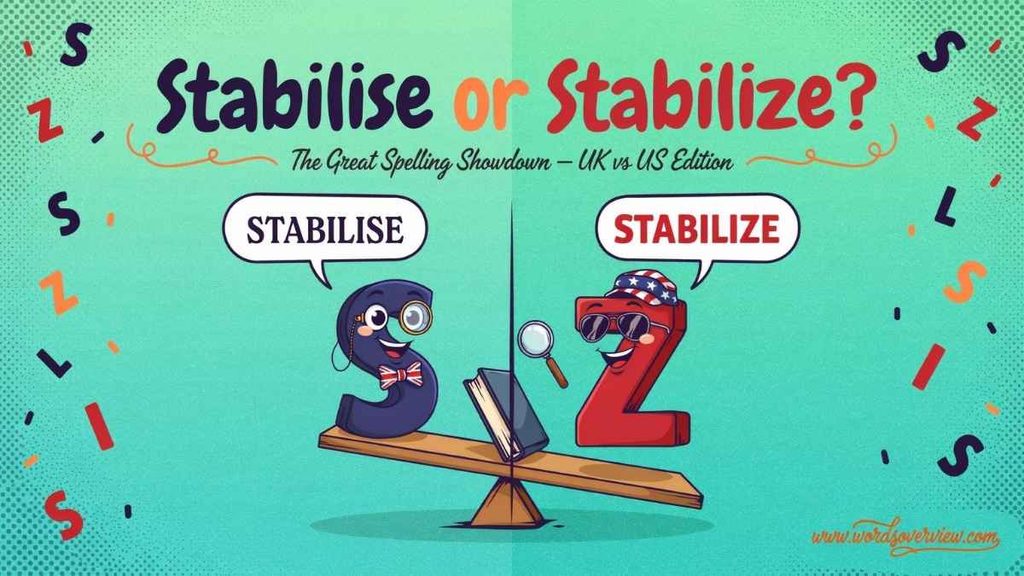
Ever stared at stabilize or stabilise and wondered whether English is playing a spelling prank on you? You’re not alone. These two forms look different, yet they carry exactly the same meaning. The real confusion comes from regional spelling habits, not grammar or pronunciation. In American English, stabilize is the standard choice. Meanwhile, stabilise appears widely in British English and other varieties that favor the “ise” ending. However, British English also accepts “ize” spellings in many contexts, so the rule isn’t quite as tidy as it first appears. In this guide, you’ll learn the difference, avoid common mistakes and confidently choose the right spelling for your audience.
Stabilize or Stabilise What’s the Difference?
The difference between stabilize and stabilise comes down to spelling rather than meaning. Both words function as verbs and describe the act of making something stable or becoming stable.
For example:
The engineers worked to stabilize the bridge.
A British English version might read:
The engineers worked to stabilise the bridge.
The meaning stays exactly the same. In both sentences, the engineers are trying to make the bridge more stable.
Stabilize and Stabilise Have the Same Meaning
Both forms can describe physical objects, medical conditions, economic situations, technical systems and general circumstances.
Consider these examples:
- The supports helped stabilize the structure.
- Doctors worked to stabilize the patient’s condition.
- The measures aim to stabilize prices.
- The update helped stabilize the software.
- The new routine helped stabilize the situation.
In British spelling, the same sentences can use stabilise instead:
- The supports helped stabilise the structure.
- Doctors worked to stabilise the patient’s condition.
- The measures aim to stabilise prices.
- The update helped stabilise the software.
- The new routine helped stabilise the situation.
Therefore, the stabilize or stabilise difference does not involve meaning. It reflects a regional spelling preference.
Learn the difference between commonly confused words in English
Months or Monthes Which Spelling Is Correct?
Stabilize or Stabilise Meaning and Definition
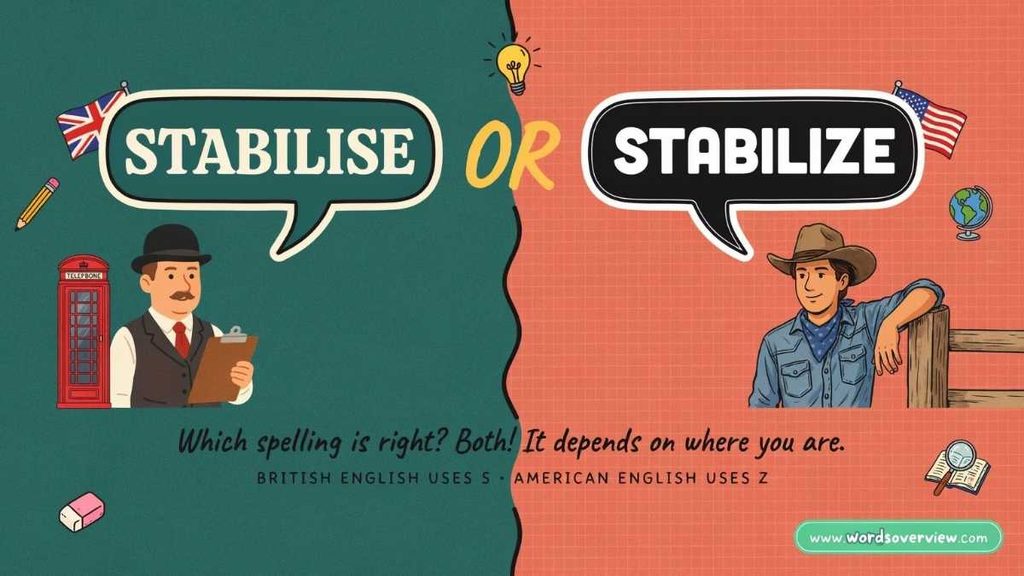
Before choosing between the two spellings, it helps to understand what the word actually means.
Stabilize Definition
The stabilize definition is to make something stable or to cause something to become stable. The verb can also describe a person, system or situation that gradually reaches a stable state.
In simple terms, to stabilize something can mean to:
- make it steady
- reduce unwanted movement
- reduce major fluctuations
- prevent sudden changes
- bring a situation under control
- maintain a stable condition
- improve consistency
For example:
The technician adjusted the equipment to stabilize the machine.
Here, the technician actively causes the machine to become more stable.
The verb can also work without a direct object:
The patient’s condition began to stabilize.
In this sentence, the condition itself becomes more stable.
Stabilise Definition
The stabilise definition is the same. Stabilise means to make something stable or to become stable.
For example:
The government introduced measures to stabilise prices.
The spelling changes, but the meaning does not, word can describe several kinds of stability:
| Context | Meaning | Example |
| Physical | Make something steady | The supports stabilized the wall. |
| Medical | Bring a condition to a stable state | Doctors stabilized the patient. |
| Economic | Reduce major fluctuations | The policy aims to stabilize the economy. |
| Technical | Improve reliability | The update stabilized the system. |
| General | Bring circumstances under control | The talks helped stabilize the situation. |
Learn the difference between similar English words the easy way
Presence or Presense Which Is Correct?
Stabilize in American English
Stabilize is the standard spelling in American English. Therefore, writers who follow US spelling normally choose this form in academic, business, technical, medical and general writing.
The same spelling pattern appears in related forms:
- stabilize
- stabilized
- stabilizing
- stabilization
- stabilizer
For example:
The market has stabilized after several weeks of volatility.
The update is stabilizing the system.
Economic stabilization may take time.
The aircraft uses a stabilizer to improve control.
Do Americans Use Stabilize?
Yes. Do Americans use stabilize? Absolutely. It is the normal US spelling.
If a document follows American English spelling, writers generally use stabilize rather than stabilise.
For example:
The treatment helped stabilize the patient’s condition.
This spelling fits the broader American pattern found in words such as:
- organize
- recognize
- realize
- centralize
- modernize
However, American spelling does not mean that every English-speaking country must use the same form. Regional English has its own conventions.
Stabilise in British English
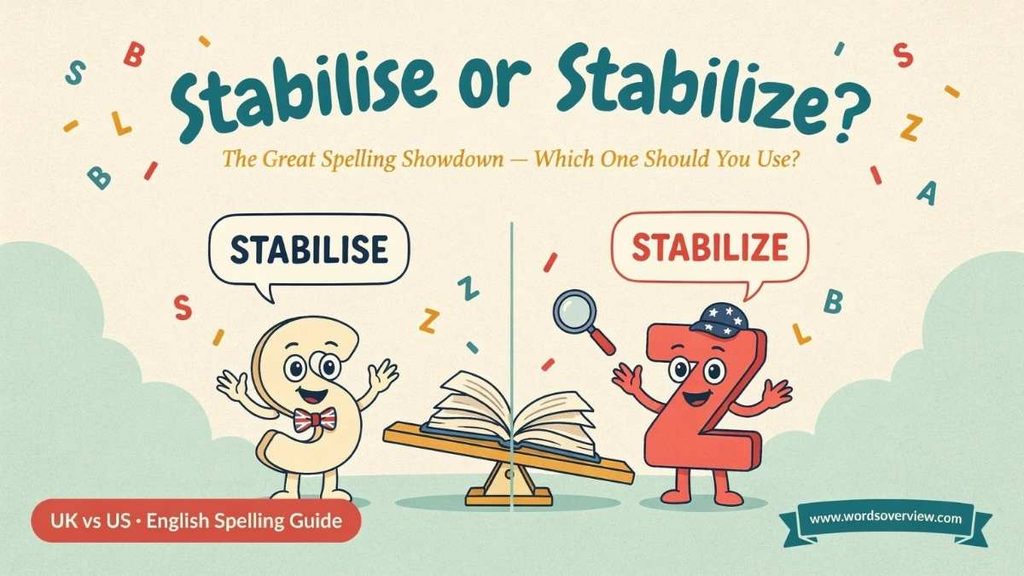
it is widely used in British English. It follows the familiar British -ise spelling pattern found in many verbs.
For example:
The treatment helped stabilise the patient’s condition.
The government hopes to stabilise the economy.
Engineers worked to stabilise the structure.
This pattern also appears in words such as:
- organise
- recognise
- realise
- centralise
- modernise
However, there’s an important detail that often gets overlooked.
Learn the difference between similar English words the easy way
Unvoluntary or Involuntary Which One Is Correct?
Is Stabilize British English?
Yes. Stabilize British English is a valid combination.
British English does not always require the -ise spelling. Some British dictionaries, publishers and style guides accept or prefer -ize forms.
As a result, the statement “British English always uses -ise” oversimplifies the language.
A more accurate rule is:
American English strongly favors -ize, while British English can use either -ise or -ize depending on the word and style guide.
For everyday British writing, however, stabilise remains a very familiar choice.
Stabilize or Stabilise American or British English
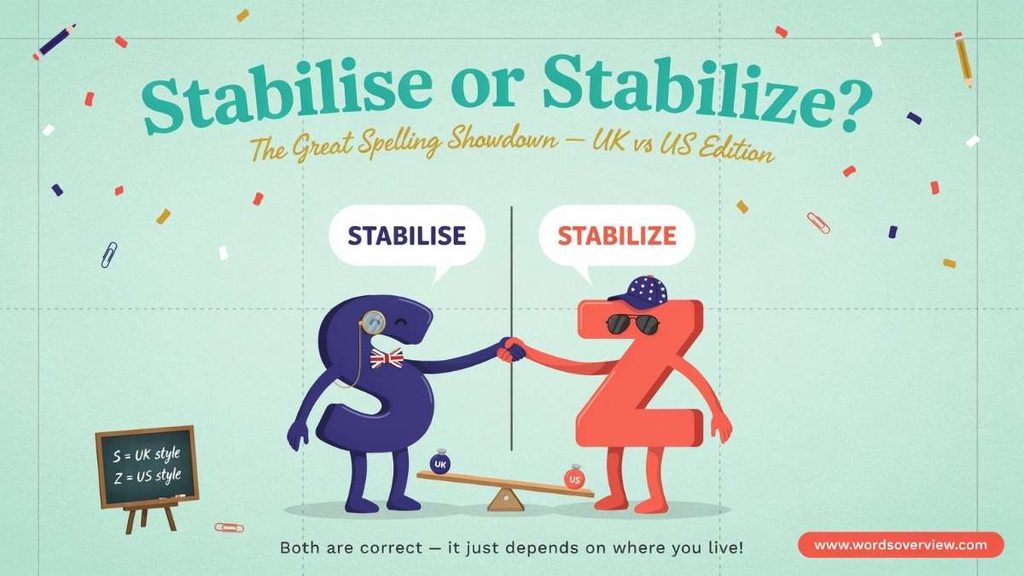
The American or British spelling distinction becomes clearer when you compare the related forms.
| American English | Common British Form |
| stabilize | stabilise |
| stabilized | stabilised |
| stabilizing | stabilising |
| stabilization | stabilisation |
| stabilizer | stabiliser |
The pattern usually continues through the word family.
For example:
The situation has stabilized.
British spelling:
The situation has stabilised.
Likewise:
The company is stabilizing production.
British spelling:
The company is stabilising production.
And:
Economic stabilization followed the reforms.
British spelling:
Economic stabilisation followed the reforms.
Why British Spelling Isn’t Always Simple
Many learners memorize a basic rule: American English uses -ize and British English uses -ise. Although this rule works for many common words, it doesn’t describe every British spelling system.
Different British publishers and institutions may follow different style conventions. Some prefer -ise, while others accept or prefer -ize.
Therefore, if you’re writing professionally, don’t rely on geography alone. Instead, check the style guide that governs your document.
That approach matters especially in academic writing, publishing, journalism and corporate communication.
Stabilize or Stabilise Spelling: Why Are There Two Forms?
The stabilize or stabilise spelling difference reflects the broader history of English spelling.
English developed regional spelling conventions over centuries. As English spread across different countries, writers, publishers, dictionaries and institutions developed preferences that gradually became established.
The -ize/-ise variation represents one of those spelling differences.
Importantly, stabilise is not simply a misspelling of stabilize. It is an established spelling variant.
The same variation appears in words such as:
- organize / organise
- recognize / recognise
- realize / realise
- modernize / modernise
- centralize / centralise
However, don’t assume that every word ending in -ise can automatically change to -ize.
For example, these words normally keep their s:
- advertise
- advise
- exercise
- revise
- surprise
- compromise
English spelling depends on word history and established usage. Therefore, the -ize/-ise pattern works for some groups of words but not as a universal replacement rule.
Stabilize or Stabilise Pronunciation
The stabilize or stabilise pronunciation is essentially the same. The spelling difference does not create a different word or change its basic pronunciation.
This distinction can confuse learners because the letters s and z often signal different sounds in English. In this particular spelling variation, however, stabilize and stabilise represent the same lexical item.
So, when you see either spelling, focus on the context rather than assuming that the spelling changes the meaning.
Learn the difference between commonly confused words in English
Classes or Class’s Meaning And Difference
Stabilize or Stabilise in Different Contexts
The verb appears in many fields. Fortunately, the spelling choice remains consistent regardless of the subject.
Science and Technology
Technical writing often uses stabilize or stabilise when discussing structures, systems, processes or materials.
Engineers added supports to stabilize the structure.
The algorithm helps stabilize the system during sudden changes.
In British spelling:
Engineers added supports to stabilise the structure.
The technical meaning remains unchanged.
Business and Economics
Business and economic writing frequently uses the verb with words such as market, prices, economy, currency, growth and conditions.
For example:
The policy aims to stabilize the currency.
Officials hope the measures will stabilise prices.
Here, the verb describes an effort to reduce significant fluctuations and create more stable conditions.
Medical Writing
Medical writing often uses the verb when discussing a person’s condition.
Doctors worked to stabilize the patient’s condition.
The phrase means that medical professionals worked to bring the patient’s condition into a more stable state.
In British spelling:
Doctors worked to stabilise the patient’s condition.
The spelling changes, but the medical meaning remains the same.
Everyday English
You can also use the word in ordinary situations:
The new schedule helped stabilize her routine.
Extra support helped stabilise the shelf.
In both examples, the basic idea involves creating greater steadiness or stability.
Learn the difference between similar English words the easy way
Boxes or Boxs Which Spelling Is Correct?
Stabilize or Stabilise: Which Spelling Should You Use?
The answer depends on your intended audience and the style you need to follow.
Use Stabilize When:
Choose stabilize when:
- You’re writing standard US English.
- Your publication follows American spelling.
- Your academic institution requires American English.
- Your company uses US English throughout its documents.
- Your target audience primarily uses American English.
The phrase stabilize US spelling therefore points to the standard American form: stabilize.
Use Stabilise When:
Choose stabilise when:
- You’re following a British style that prefers -ise.
- Your publication consistently uses British -ise forms.
- Your institution or editor specifically requests British -ise spelling.
- Your surrounding vocabulary already follows that convention.
The phrase stabilise UK spelling commonly refers to this British preference.
What If You’re Writing for a Global Audience?
For an international audience, either form can work. The important thing is consistency.
For example, if a website consistently uses American spellings such as organize, recognize and stabilize, switching suddenly to organise, recognise and stabilise can make the content look inconsistent.
Likewise, a publication that consistently follows British -ise spelling should normally maintain stabilise throughout.
When a style guide exists, follow it. That rule removes most uncertainty.
Stabilize or Stabilise in Australian and New Zealand English
English varieties outside the United States and United Kingdom add another layer to the spelling question.
Australian English spelling and New Zealand English spelling share many features with British English. However, neither variety should be treated as a perfect copy of UK English.
Australian and New Zealand publishers, dictionaries, schools and organizations can establish their own conventions.
Therefore, searches such as stabilize Australian English, stabilise Australian English, stabilize New Zealand English and stabilise New Zealand English don’t always have a useful one-word answer.
The safest professional approach is to follow the relevant regional dictionary or style guide.
The same principle applies more broadly to Commonwealth English spelling. Commonwealth countries don’t all follow one identical spelling system.
Learn the difference between basic English word mistakes
Address or Adress Which Spelling Is Correct?
Stabilize or Stabilise Grammar and Related Forms
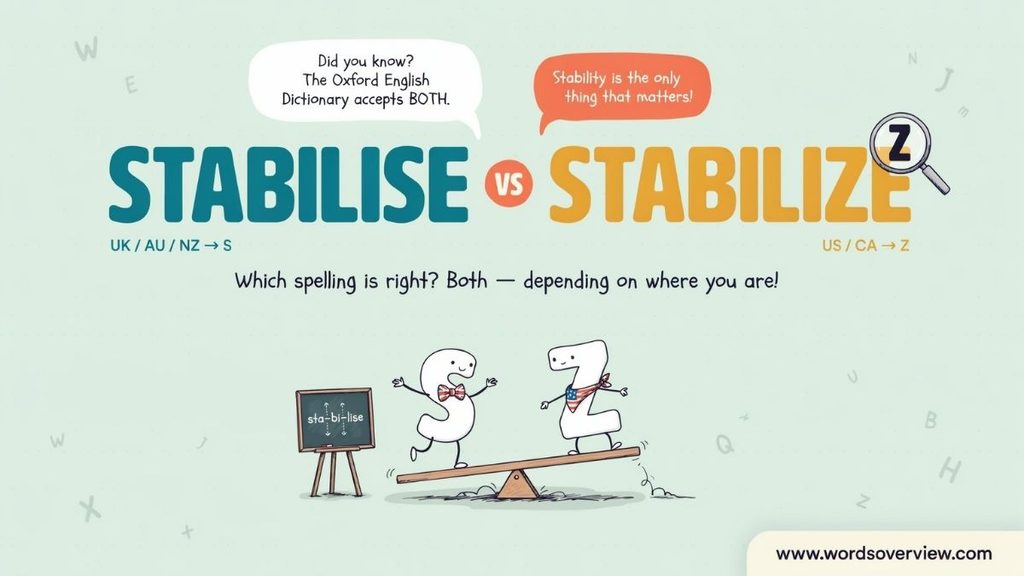
The spelling difference continues through the word family.
| Word Form | American English | Common British Form |
| Base verb | stabilize | stabilise |
| Third-person singular | stabilizes | stabilises |
| Past tense | stabilized | stabilised |
| Past participle | stabilized | stabilised |
| Present participle | stabilizing | stabilising |
| Noun | stabilization | stabilisation |
| Related noun | stabilizer | stabiliser |
Stabilized or Stabilised
Both forms describe the past tense or past participle of the verb.
American English:
The market stabilized after the announcement.
British English:
The market stabilised after the announcement.
Stabilizing or Stabilising
The same regional distinction appears in the present participle.
American English:
The company is stabilizing production.
British English:
The company is stabilising production.
Learn the difference between similar English words the easy way
Alternately or Alternatively Meaning and Difference
Stabilization or Stabilisation
The noun follows the same spelling pattern.
American English:
Economic stabilization may take several months.
British English:
Economic stabilisation may take several months.
Stabilizer or Stabiliser
A stabilizer or stabiliser is something that helps maintain stability.
For example:
The aircraft’s stabilizer improves control.
British spelling:
The aircraft’s stabiliser improves control.
Learn the difference between commonly confused words in English
Trialled or Trialed Which Is Correct?
Stabilize or Stabilise Common Mistakes
Although the spelling difference looks simple, several common mistakes can cause confusion.
Mistake: Calling Stabilise Incorrect
Some writers assume that stabilise must be wrong because American English uses stabilize.
That’s not the case. Stabilise is a well-established spelling, especially in British English.
Mistake: Calling Stabilize Only American
The opposite assumption also causes problems.
Although stabilize is standard in American English, British English can also use the -ize form. The exact preference depends on the style authority being followed.
Mistake: Mixing Regional Spellings
Mixing spelling conventions can make otherwise polished writing look inconsistent.
For example:
The company stabilized production and organised a new training program.
If the document follows American spelling, a consistent version would be:
The company stabilized production and organized a new training program.
If it follows a British -ise convention, you might write:
The company stabilised production and organised a new training program.
Consistency creates a cleaner reading experience.
Mistake: Assuming the Meaning Changes
The spelling does not change the core meaning.
Stabilize and stabilise both describe making something stable or becoming stable.
Learn the difference between often confused words
Pre vs Post Meaning, Difference and Grammar Rules
Stabilize or Stabilise Synonyms and Antonyms
A stabilize or stabilise synonym depends on the context. Several words can express a similar idea, but they don’t always carry exactly the same meaning.
Useful alternatives include:
- steady
- secure
- strengthen
- balance
- settle
- regulate
- maintain
- reinforce
For example, steady works well when something needs physical control:
She steadied the camera.
However, stabilize often carries a broader meaning:
The software update stabilized the system.
Likewise, secure can describe fastening or protecting something, while stabilize focuses more directly on creating or maintaining stability.
Stabilise or Stabilize Antonyms
For stabilise or stabilize antonyms, the strongest direct opposite is generally destabilize or destabilise.
Other context-dependent opposites include:
- unsettle
- disrupt
- weaken
- disturb
- destabilize
- destabilise
For example:
The sudden policy change destabilized the market.
This sentence describes the opposite process of stabilizing the market.
Stabilize or Stabilise Comparison Table
| Feature | Stabilize | Stabilise |
| Part of speech | Verb | Verb |
| Basic meaning | Make or become stable | Make or become stable |
| Standard US spelling | Yes | No |
| Common UK spelling | Yes, in some styles | Yes |
| Meaning difference | None | None |
| Basic pronunciation | Same | Same |
| Past tense | stabilized | stabilised |
| Present participle | stabilizing | stabilising |
| Noun | stabilization | stabilisation |
| Related noun | stabilizer | stabiliser |
Learn the difference between often confused words
Employees or Employee’s Which Is Correct?
Stabilize or Stabilise: Quick Facts
- Stabilize and stabilise are both established English spellings.
- Both forms have the same basic meaning.
- Stabilize is the standard US spelling.
- Stabilise is widely used in British English.
- Stabilize also appears in British English.
- British spelling conventions vary among publishers and institutions.
- The pronunciation is essentially the same.
- Related forms show the same regional variation.
- Stabilization corresponds to stabilisation.
- Stabilized corresponds to stabilised.
- Stabilizing corresponds to stabilising.
Consistency matters when choosing between regional spelling systems.
Practice Session: Stabilize or Stabilise
Fill in each blank with the correct form of stabilize or stabilise. The exercises test spelling, meaning, regional usage and related forms.
Fill in the Blanks
- The doctor worked quickly to ________ the patient’s condition.
- The engineers added extra support to ________ the bridge.
- The economy began to ________ after several difficult months.
- In American English, the preferred spelling is usually ________.
- In British English, you may commonly see the spelling ________.
- The technician managed to ________ the computer system.
- The company hopes to ________ prices before the end of the year.
- The patient’s condition ________ after receiving treatment.
- The camera software can ________ shaky video footage.
- The government introduced measures to ________ the financial market.
- Both “stabilize” and “stabilise” have the same ________.
- The team used a support frame to ________ the structure.
- After several hours, the patient’s condition finally ________.
- The British spelling commonly uses -ise, while the American spelling commonly uses ________.
- The new medication helped ________ his condition.
- The company needs to ________ its operations before expanding.
- The weather conditions gradually ________ during the afternoon.
- A strong foundation can help ________ the building.
- The spelling difference between “stabilize” and “stabilise” is mainly ________ rather than a difference in meaning.
- The nurse monitored the patient until his condition ________.
- The technician adjusted the equipment to ________ the machine.
- The financial measures were designed to ________ the market.
- In a British-style document, the writer may choose ________ for consistency.
- In a US English document, the writer should normally use ________.
- Once the situation began to ________, the team could focus on long-term solutions.
Answer Session
- stabilize / stabilise
- stabilize / stabilise
- stabilize / stabilise
- stabilize
- stabilise
- stabilize / stabilise
- stabilize / stabilise
- stabilized / stabilised
- stabilize / stabilise
- stabilize / stabilise
- meaning
- stabilize / stabilise
- stabilized / stabilised
- -ize
- stabilize / stabilise
- stabilize / stabilise
- stabilized / stabilised
- stabilize / stabilise
- spelling
- stabilized / stabilised
- stabilize / stabilise
- stabilize / stabilise
- stabilise
- stabilize
- stabilize / stabilise
Here’s a trusted source for clear more words Comparison:
Grammar Update
Frequently Asked Questions
Is it stabilize or stabilise?
Both stabilize and stabilise are correct spellings of the same verb. Stabilize is the standard spelling in American English, while stabilise is widely used in British English. British English also uses stabilize in styles that prefer the -ize ending.
How do you spell stabilize?
The standard American English spelling is stabilize, with a z. The spelling stabilise, with an s, is also correct and appears widely in British English and some other varieties of English.
What does the word stabilize mean in English?
Stabilize means to make something stable or to help something become stable. For example, a government may stabilize the economy or a technician may stabilize a system to prevent sudden changes.
What does “stabilise” mean?
Stabilise has the same meaning as stabilize. It means to make something stable, steady or less likely to change. The difference between the two forms is spelling rather than meaning.
How do you spell stabilize in the UK?
In the UK, you may see both stabilise and stabilize. Stabilise is widely used, while stabilize is also accepted by many British dictionaries and style systems that favor -ize spellings.
What does it mean for something to stabilize?
When something stabilizes, it becomes steady or reaches a condition with less fluctuation. For example, if prices stop rising and remain relatively steady, you could say that prices have stabilized.
What does it mean when you stabilize someone?
To stabilize someone means to help the person reach a safer and more stable condition. In medical contexts, it can refer to immediate care that helps control a person’s condition before further treatment.
What is another word for stabilize?
Depending on the context, alternatives for stabilize include steady, secure, strengthen, balance, settle, regulate, maintain and reinforce. The best synonym depends on whether you mean physical stability, emotional steadiness, financial control or system reliability.
How do you pronounce stabilise?
Stabilise and stabilize are generally pronounced the same way in standard English. The spelling changes, but the pronunciation and meaning remain essentially the same.
What does stabilize mean medically?
In medical English, stabilize means to bring a patient’s condition under control or prevent it from becoming worse. For example, medical professionals may stabilize a patient before moving on to additional treatment.
Conclusion
The stabilize or stabilise confusion looks bigger than it really is. Fortunately, there’s no grammar emergency here. Both spellings are correct, both have the same meaning and both work as verbs that describe making something stable or becoming stable. The main difference comes down to regional spelling preferences.
In American English, stabilize is the standard spelling. In British English, stabilise is widely used, although stabilize also appears in British writing, especially in styles that favor the -ize ending. Australian and New Zealand English can follow similar patterns.
So, which spelling should you choose? Match your audience, follow the style guide you’re using and most importantly, stay consistent. Once you know the regional difference, stabilize or stabilise stops being a spelling mystery and becomes just another small quirk of English.

Ethan AJS is an experienced blogger and language enthusiast at Words Overview, dedicated to making English easier to understand and use. He writes about grammar, vocabulary, spelling, word meanings and commonly confused words, turning tricky language questions into clear, practical insights. With a passion for effective communication, Ethan creates engaging, readerfocused content that helps readers write accurately, choose the right words and communicate with confidence.




